
Reformer Pilates has moved far beyond its reputation as a boutique fitness trend for dancers and yoga enthusiasts. Walk into a clinical rehabilitation studio today and you’ll find the same spring-loaded machine being used to help someone recover from spinal surgery, manage multiple sclerosis, or support certain cancer rehabilitation programmes. This article answers four questions that matter before you book your first class: what the reformer actually is and how it works, whether it suits your specific goals, what you’ll pay across Australia in 2026, and exactly how to prepare for day one. Getting those answers right matters, because instructor qualifications and programme design strongly influence your outcomes, the equipment alone is not sufficient.
What reformer Pilates is and how the machine works
The anatomy of a Pilates reformer
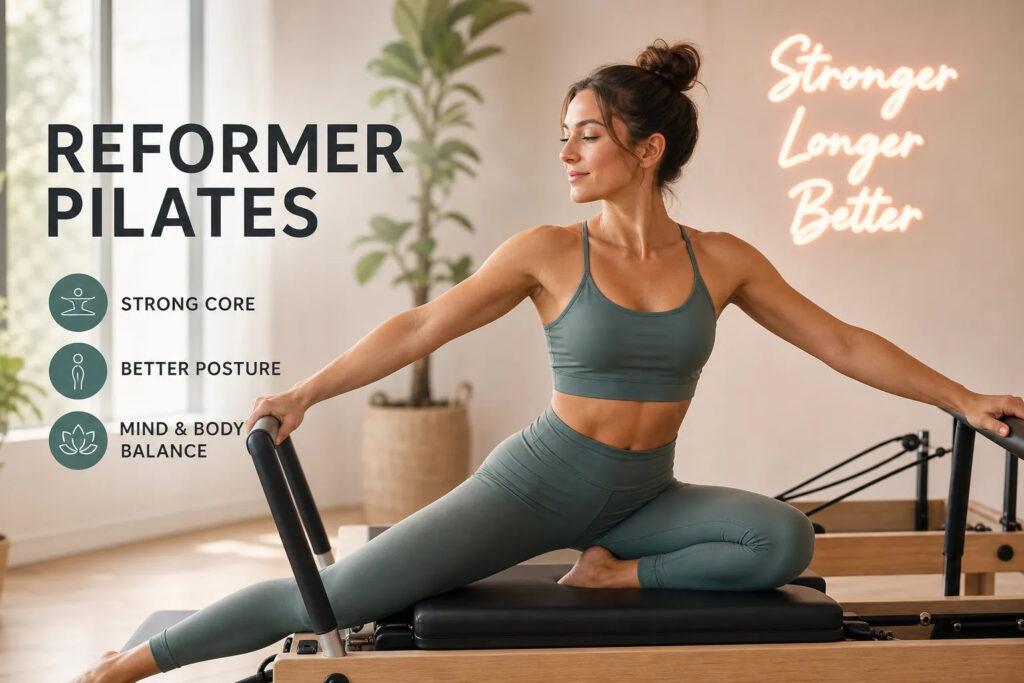
The reformer is a rectangular frame with a padded sliding carriage that moves back and forth along horizontal rails. Attached to the carriage are colour-coded springs that connect to a fixed end of the frame, providing resistance as you push or pull the carriage away. Note that colour coding does vary between manufacturers, so always confirm spring weights with your instructor. At the front of the machine sits the foot bar, which you press through with your feet or hands during foundational exercises. Adjustable shoulder blocks keep your body positioned on the carriage, and two looped straps hang from a pulley at the top end for arm and leg work.
The spring system is the reformer’s defining feature. Because resistance is fully adjustable, the same machine can support a 70-year-old rebuilding after a hip replacement and a competitive athlete working on single-leg power. Instructors dial the load up or down by adding or removing springs, making the reformer a highly versatile piece of exercise equipment across a wide range of clinical applications.
How it differs from mat Pilates
Mat Pilates relies entirely on bodyweight and gravity, which demands significant existing core control to execute correctly. The reformer adds guided resistance through those springs and introduces a dynamic moving surface, which changes the neuromuscular challenge entirely. As the carriage slides, your body must continuously stabilise against that movement, training the deep muscles that support your joints in a way that bodyweight exercise alone cannot replicate. Clinical trial data from the past decade demonstrates that this loaded, guided movement transfers effectively into both strength training and rehabilitation outcomes.
Joseph Pilates originally designed the reformer to complement floor-based practice, not replace it. The two approaches work well together: mat work builds foundational body organisation, while the reformer teaches you to apply that organisation under load. Neither is superior; they serve different purposes depending on where you are in your training or recovery.
Who reformer Pilates actually suits (it’s broader than most people think)
The fitness crowd: from beginners to athletes
One of the most persistent misconceptions about reformer Pilates is that it’s designed for people who already move well. It’s not. Because the springs can be set to provide support rather than just resistance, complete beginners often find the reformer more manageable than mat work in their first few sessions. A heavier spring load stabilises the carriage, reducing the coordination demands while you’re learning the fundamentals. As your control improves, the instructor reduces spring load to progressively challenge your neuromuscular system.
At the other end of the spectrum, athletes use the reformer to address the functional gaps that conventional gym training misses. Runners benefit from the emphasis on single-leg stability and hip alignment. Swimmers develop better shoulder blade control and thoracic rotation. Dancers use it for articulation and controlled range of motion. The reformer’s ability to load the body in unusual planes of movement makes it a useful training tool long after someone has outgrown beginner classes.
The rehabilitation and clinical case
Reformer Pilates earns its place in evidence-based rehabilitation for a broad range of conditions: chronic back and neck pain, postnatal pelvic floor recovery, neurological disorders, osteoporosis, fibromyalgia, and post-surgical joint rehabilitation. The spring-loaded resistance allows clinicians to load movement patterns precisely, which is difficult to achieve with bodyweight alone or conventional gym machines. This is where the studio you choose matters significantly.
The benefits backed by evidence, not just marketing
Physical gains: strength, core, and flexibility
Clinical trial data from the past decade consistently demonstrates that a structured reformer programme produces measurable increases in trunk strength, muscle endurance, dynamic balance, and postural alignment. An eight-week programme practised two to three times per week produces significant strength gains; one comparative trial found greater trunk strength gains from reformer-based Pilates than from mat-based Pilates alone. The reformer’s guided range of motion also improves joint support without the shear forces associated with loaded gym exercises, which is why it works well in populations with joint sensitivity.
Balance improvements are particularly well documented in adults over 60. The reformer’s controlled instability trains the same postural reflexes that underpin fall prevention, and for this population the evidence base is robust. For athletes, specific documented outcomes include improved agility, lower limb power, and movement efficiency, benefits that extend well beyond the studio floor.
Beyond the physical: mental health and clinical outcomes
Peer-reviewed research documents that a six-week reformer programme can significantly reduce pain intensity, fear of movement, fatigue, and sleep disruption in people with chronic musculoskeletal pain. Reductions in anxiety and depression scores are also reported, which is clinically relevant for people whose chronic pain has eroded their confidence in moving. These are reproducible outcomes from published trials, not vague wellness claims.
For specific conditions, the evidence is similarly strong. Reformer Pilates is recognised as a first-line intervention for non-specific chronic low back pain. It is used to rebuild pelvic floor function and core stability in postnatal recovery. In neurological rehabilitation, it supports neuromuscular re-education for conditions including multiple sclerosis and post-stroke recovery. Across all of these applications, the reformer’s capacity for precise, low-impact loading is what makes it appropriate for healing or compromised systems.
What to expect in your first reformer Pilates session
Class structure and how a typical session flows
Most classes run for 45 to 60 minutes. A standard session typically includes the following sequence:
- Footwork on the foot bar, establishes breath, leg engagement, and spinal alignment from a lying position
- Core sequence, pelvic curls, bridging, and abdominal work
- Upper body exercises using the straps
- Lower body work including leg presses and circles
- Spinal mobility and extension
- Cool-down stretch
Some studios follow this traditional linear order; others use a circuit format with repeated exercise blocks. Either way, the session is structured to move progressively through the body rather than targeting isolated muscle groups.
The pace in an introductory class will feel deliberately slow. Pilates prioritises movement quality over speed. The nervous system also needs time to learn new coordination patterns. Many beginners expect to break a sweat immediately and feel surprised when the class is quiet and controlled. That’s not a sign the workout isn’t effective, it means the instructor is doing their job correctly. Many participants report significant muscular fatigue arriving 24 to 48 hours later, once the deep stabilisers have been challenged in ways they’re not accustomed to.
How to prepare before you walk in
Arrive 10 minutes early and let the instructor know you’re new. This gives them time to note any injuries or health conditions before class starts, rather than managing modifications on the fly. Wear form-fitting clothes, fitted leggings and a snug top, so the instructor can see your spinal alignment and hip position during exercises. Baggy clothing catches in the springs and makes cueing much harder.
Grip socks are recommended at most Australian studios for safety and hygiene. If you don’t own a pair, most studios sell them at reception or you can purchase them in advance online from reputable companies like Gripperz Socks. Pack a water bottle and tie your hair back if it’s long. Save detailed questions for after class so the session stays focused for everyone in the group. Feeling slightly uncertain in your first class is completely normal; most people feel significantly more confident by their second or third session once the equipment becomes familiar.
How much reformer Pilates costs in Australia
Single classes, class packs and memberships
Across Australia in 2026, a casual single reformer class typically sits between $28 and $50. Sydney holds the highest rates, with inner-city and beachside studios charging $35 to $60 per class. Melbourne averages $30 to $45, with premium studios at the top of that range. Brisbane and Perth are generally more affordable at $28 to $42, and Adelaide sits lower again, typically $25 to $35. A ten-class pack brings the per-session cost down to roughly $19 to $30 depending on the studio, while monthly unlimited memberships range from $180 to $350 nationally.
Private one-on-one sessions represent a significant price jump, typically $80 to $150 or more per hour. For people with complex health conditions or specific rehabilitation goals, that investment is often warranted because the session is structured entirely around their needs. Clinical studios may price differently to account for the added expertise and individualised programming involved, which is worth factoring into any cost comparison. Studios operated by Allied Health professionals may also offer Health Insurance rebates so be sure to ask before booking in.
Making sense of introductory offers
Most studios run introductory promotions, commonly three classes for $40 to $99, which make it easy to trial the format without committing to a large pack. Use this period deliberately: attend different class times to assess whether group sizes stay small, watch how the instructor manages modifications for participants with different needs, and notice whether you receive individual feedback during the session or whether the instructor is primarily managing the group from the front. The introductory offer is your due diligence window, not just a discount.
How to choose the right reformer studio for your goals
What to look for beyond the Instagram feed
Instructor qualifications are the single most important factor to investigate, and they vary significantly across the industry. A standard reformer instructor typically holds a Certificate IV or Diploma in Pilates instruction, which is a vocational qualification with no allied health prerequisite. A clinical Pilates instructor holds an allied health degree (physiotherapy, osteopathy, exercise physiology, or equivalent) combined with postgraduate-level clinical Pilates training, and is registered with AHPRA or a recognised professional body. For general fitness goals, a well-qualified studio instructor is often sufficient. For rehabilitation or clinical management of a health condition, the distinction is critical.
Class size is the second variable worth scrutinising. A class of twelve with one instructor means you’ll receive minimal individual feedback, which matters when alignment is the whole point of the exercise. Smaller groups, four to eight participants, generally allow the instructor to observe and cue each person throughout the session, which is where the real clinical value sits. Consider asking directly about maximum class sizes before you book; a studio confident in its model will answer clearly.
When your goals go beyond general fitness
For anyone managing a health condition, recovering from surgery, or returning to exercise after illness, a standard boutique studio is unlikely to have the clinical infrastructure to support you safely. Programmes like those at Living Energy Brain Body Rehab in Macleod, Melbourne, are specifically designed to fill that gap: small-group Reformer sessions run by clinical exercise professionals, where each participant’s programme reflects their condition, goals, and movement history. If you have a specific health concern, ask any studio directly whether they have experience managing it before you book. A studio confident in its clinical capability will answer that question clearly and without hesitation.
Starting reformer Pilates: making the right decision for you
Reformer Pilates is a versatile, evidence-supported modality that serves a far wider range of people than its boutique reputation suggests. The key decisions come down to three practical factors: finding a studio whose instructors hold qualifications appropriate to your health needs, keeping class sizes small enough for genuine individual attention, and confirming that programmes are built around your goals rather than a fixed template.
If you’re managing a health condition or returning to exercise after injury or illness, choosing a clinical studio removes both the guesswork and the risk from your first session. Whether that means booking a trial class, using an introductory offer to compare your options, or speaking directly with a clinician about whether reformer Pilates suits your situation, the next step is simply making the enquiry.